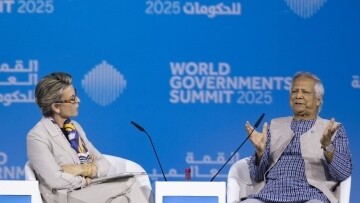
Professor Muhammad Yunus, the chief advisor of the interim government of Bangladesh, spoke at a session of the World Summit of Governments 2025 and in an open conversation with Becky Anderson from CNN discussed the burning political situation in the country and the vital work that is necessary for the restoration of stability. The Nobel Peace Prize laureate Yunus took on the role of chief advisor, a responsibility he never shied away from, but accepted due to the urgent needs of the country.
"There is no regret, but this is a bigger task," Yunus replied, reflecting on his role as chief advisor, and to Anderson's question about whether he regrets taking on this role. At that time, he was focused on promoting social business and microcredit globally, including his work on creating the Paris Olympic Games as a social business, he returned to Bangladesh when an urgent situation arose.
According to Yunus, the immediate priority for the interim government is to restore law and order and ensure that the country can prepare for free and fair elections planned for the end of 2025 or the beginning of 2026. Alongside immediate economic and political tasks, Yunus emphasized the necessity of national reconciliation and fairness.
In his broad vision of the future Bangladesh, Yunus called for a new economic model, focused on satisfying human needs rather than maximizing profits. "When my task is fulfilled, I will hand over the responsibility to the elected government and return to that which aligns more with my principles," he confirmed.
The session highlighted enormous challenges facing which Yunus leads Bangladesh towards a new chapter, with an emphasis on restoring institutions, restoring democracy, and overcoming the economic crisis. "Since we want to do this, we need to pull this out of us, so that it happens," Yunus noted, stressing that business must address social issues such as health care, education, and technology without having as its sole goal the generation of profit.
Furthermore, he plans to leave as soon as the elections take place and the elected government assumes power.